What Is the Best Indoor Advertising Display in China?

Time:2026-10-02 Author:Liam
0%

Choosing the best Indoor Advertising Display in China requires more than comparing screen size and price. The strongest option must fit local traffic patterns, store lighting, content needs, and service conditions.

China had approximately 1.1 billion internet users in January 2025, according to DataReportal’s Digital 2025: China report. This connected audience raises expectations for faster, clearer, and more relevant brand communication. WARC’s 2024 Global Advertising Trends also highlights digital out-of-home media as a measurable channel for location-based campaigns. However, indoor environments remain complicated. A bright shopping mall, a dim hotel lobby, and a crowded railway retail area need different display settings.

The best Indoor Advertising Display usually combines 4K resolution, strong anti-glare performance, stable 24/7 operation, and a reliable content management system. Local installation support matters just as much. A beautiful panel becomes a weak investment when replacement parts take weeks to arrive. That happens.

Florian Rotberg, managing director of invidis consulting, has described digital signage as “not simply a screen, but a communication medium.” This principle deserves attention. The display should guide attention, support customer decisions, and work with the surrounding space. In practical evaluations, 500–700 nits may suit many indoor retail locations, while excessive brightness can create glare and unnecessary energy use. A larger screen is not automatically better. My own assessment would also examine viewing distance, operating temperature, warranty response, and software usability. The final choice should balance visual impact with measurable performance, not follow a fashionable specification list.
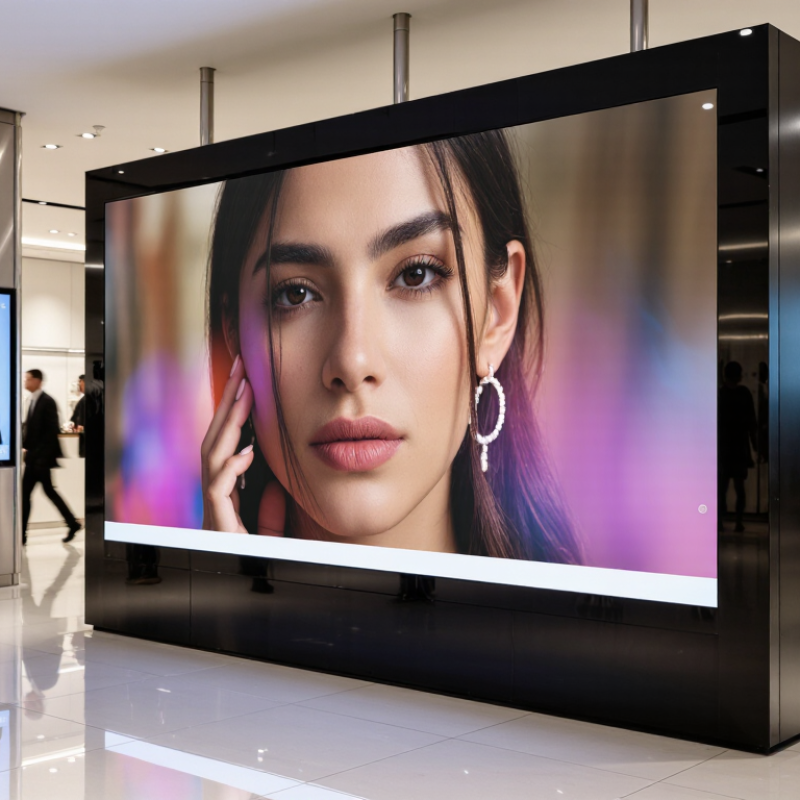
What Is the Best Indoor Advertising Display in China?

Definition and Role of Indoor Advertising Displays in China

An indoor advertising display is a screen placed inside commercial or public spaces to deliver paid messages, information, or interactive content. In China, it appears in shopping centers, office lobbies, transport hubs, hotels, and community facilities. Its role is not simply to show bright images. It connects physical locations with digital campaigns, guiding attention when people are waiting, walking, or making purchase decisions.

The audience is substantial. The CNNIC 54th Statistical Report records 1.099 billion Chinese internet users and a 78.0% internet penetration rate in 2024. Indoor displays can extend this connected behavior into offline spaces through QR codes, mobile pages, and real-time content. Statista Market Insights estimated China’s out-of-home advertising revenue at roughly US$9 billion in 2024, showing the commercial value of location-based exposure.

Still, a larger screen is not automatically better. A practical display needs readable contrast, stable playback, suitable brightness, and accurate audience measurement. A crowded lobby may need short messages, not cinematic storytelling. I have seen attractive screens fail when reflections hide the text. That weakness deserves attention. Content timing, viewing distance, and maintenance often matter more than impressive hardware.

Main Types of Indoor Advertising Displays and Their Uses

The best indoor advertising display in China depends on location, audience, and message length.

LCD signage works well in malls, hotels, clinics, and office lobbies. It provides sharp images for promotions, menus, and service information. Large LED walls create stronger visual impact in spacious atriums or transport halls. However, they may look excessive in narrow corridors.

Interactive kiosks suit retail entrances and exhibition spaces. Visitors can search products, scan information, or request assistance. Elevator screens are useful for repeated, short messages. Projection systems can create flexible event backgrounds, but ambient light may weaken their images.

Tips: Measure viewing distance before choosing screen size. Test brightness at different times of day. Leave access space for cleaning and repairs. Content should match the display type. A simple offer may need only ten seconds. A product guide needs clearer navigation and more time. In busy areas, muted motion often performs better than constant animation.

Professional installation also requires stable mounting, safe cable routing, reliable network access, and scheduled maintenance. Indoor humidity, dust, heat, and crowded foot traffic can affect performance. A display that looks impressive on delivery day may become dull after months without care.

This is an easy detail to overlook. Content teams should review screen readability from standing and walking positions. They should also check whether text is large enough for older visitors.

No single display wins every indoor setting. The right choice balances visibility, operating cost, maintenance effort, and user comfort.

Key Factors for Comparing Display Quality and Performance

Choosing the best indoor advertising display in China starts with display quality, not screen size alone. In project evaluations, I inspect brightness, contrast, color accuracy, viewing angles, and pixel consistency. A bright screen can still look harsh under cool ceiling lights. For a lobby near windows, measure performance at morning, noon, and evening. This reveals problems that showroom demonstrations often hide. Good detail matters.

Performance comparisons should include refresh rate, thermal control, power stability, and playback reliability. I test fast movement, skin tones, small text, and dark scenes from several viewing distances. A stable image should not flicker on a phone camera. Nor should the display develop visible seams after continuous operation. Check heat around the rear panel after four hours. Excessive warmth may signal weak ventilation or inefficient components. Ask for measured data, not vague claims. Independent testing reports and clear warranty terms improve trust.

Installation conditions also shape results. A display with excellent specifications may fail in a dusty shop or crowded transit corridor. Confirm service response, spare-part availability, brightness adjustment, and remote monitoring before purchase. I have learned that “best” depends on content, audience distance, and operating hours. My earlier comparisons focused too heavily on peak brightness. That was a mistake. Lower brightness, calibrated carefully, often produces more natural faces and less viewer fatigue. Leave room for real-world testing.

What Is the Best Indoor Advertising Display in China?

Key factors for comparing display quality and performance

This normalized benchmark compares common indoor display technologies across brightness consistency, color and contrast, viewing angle, energy efficiency, and expected service life. Higher scores indicate stronger suitability for indoor advertising environments. Direct-view LED performs best where high brightness, large-format visibility, and long service life are priorities, while LCD offers a balanced choice for standard indoor applications.

Scores are based on representative technology-level specifications and typical indoor operating conditions; actual performance varies with pixel pitch, panel design, installation environment, content, and maintenance.

Leading Indoor Advertising Display Technologies in China

China’s leading indoor advertising display technologies include fine-pitch LED, LCD video walls, projection systems, and transparent LED. The best choice depends on viewing distance, room lighting, content type, and maintenance access. Fine-pitch LED creates seamless images in shopping malls, airports, and reception halls. It performs well from several meters away. LCD walls offer sharp details and predictable brightness, but visible bezels can interrupt large visuals. Projection remains flexible for temporary campaigns. Ambient light can weaken it.

Brightness matters. On-site tests often reveal problems that specifications miss. A 1.5 to 2.5 millimeter LED pitch may suit a busy lobby with close viewers. However, excessive brightness can cause discomfort and reduce content quality. LCD displays usually provide stable color for menus, product details, and short videos. Their panel seams need careful planning. Transparent LED can attract attention near glass entrances, although daylight and reflections may reduce contrast. OLED offers deep blacks, but installation cost and long-term service planning require closer review.

Reliable deployment also depends on calibration, heat control, power protection, and content scheduling. Technicians should inspect viewing angles, cable routes, ventilation, and cleaning access before installation. A display may look impressive during a launch and still become difficult to maintain later. That trade-off matters. Some projects overvalue resolution and undervalue service access. I would also question fixed brightness settings, because changing indoor light affects comfort throughout the day. Performance should be checked at opening time, midday, and evening.

What Is the Best Indoor Advertising Display in China? – Leading Indoor Advertising Display Technologies in China
Display Technology Typical Indoor Brightness Typical Resolution / Pixel Characteristics Typical Viewing Angle Typical Service Life Typical Power Consumption Best Indoor Applications Main Advantages Key Limitations Overall Suitability
Commercial LCD Display 300–1,000 nits Full HD to 4K UHD; pixel pitch is generally below 0.3 mm at normal viewing distances Approximately haze-free diagonal viewing; commonly 178° horizontal/vertical Approximately 30,000–60,000 operating hours Approximately 80–250 W per 55-inch-class screen, depending on brightness Retail signage, menu boards, elevators, reception areas, control rooms Sharp text, mature supply chain, simple installation, predictable image quality Visible bezels; limited scalability for very large seamless walls Best for general-purpose signage
Direct-View Fine-Pitch LED 600–2,500 nits for typical indoor configurations Approximately 0.7–3.9 mm pixel pitch; resolution depends on display size and module layout Usually 140°–160° horizontal and vertical Approximately 80,000–100,000 hours to about 50% initial brightness, depending on operating conditions Approximately 250–800 W/m² during typical content; higher at full white Shopping malls, atriums, stages, large lobbies, broadcast backgrounds Seamless large formats, high brightness, strong scalability, easy service access Higher initial cost; power and image quality vary with pixel pitch and calibration Best for large-format impact
OLED Display 400–1,000 nits, depending on panel type and content Full HD to 4K UHD; self-emissive pixels with no conventional backlight Typically greater than 160° with minimal color shift Approximately 30,000–100,000 hours, with content and brightness affecting longevity Approximately 100–250 W for a large commercial panel, depending on image content Premium retail, museums, hotels, showrooms, luxury interior spaces Excellent black levels, high contrast, slim profile, wide viewing angle Potential image retention or burn-in with static content; generally higher cost Best for premium visual quality
Projection Display Typically 1,500–10,000 ANSI lumens; perceived screen brightness depends on screen size and ambient light WXGA, Full HD, or 4K-class output; image sharpness decreases as screen size increases Depends on the lens and projection surface; wide-angle viewing may reduce uniformity Laser light sources commonly provide approximately 20,000–30,000 hours Approximately 200–800 W per projector, depending on brightness and operating mode Immersive exhibitions, event venues, museums, meeting spaces, architectural projection Very large image sizes, flexible aspect ratios, relatively low display-surface cost Sensitive to ambient light, requires throw distance, and may need periodic alignment Best for immersive environments
Electronic Paper Display Reflective; no conventional backlight, so readability depends on ambient illumination Commonly 800 × 600 to 1,600 × 1,200 pixels; color models generally have lower color saturation Approximately 170° or wider for many panels Panel life often exceeds 5 years; battery life depends on update frequency and connectivity Very low average power; energy is mainly used during image updates Price tags, shelf labels, directional signs, schedules, low-change information Excellent readability in bright ambient light, low energy use, no glare from a backlight Slow refresh, limited animation, lower color performance, and poor visibility in darkness without front lighting Best for low-power static content
Transparent LED Display Approximately 1,000–5,000 nits, depending on pixel pitch and transparency design Commonly 3.9–10 mm pixel pitch; effective resolution is lower than solid-screen LED at the same size Typically 120°–160° horizontal and vertical Approximately 80,000–100,000 hours to about 50% initial brightness Approximately 200–600 W/m² during typical content, depending on brightness and transparency Storefront windows, glass façades, atriums, airports, exhibition spaces Maintains visibility through glass, enables creative façade advertising, and supports large sizes Lower resolution and contrast than solid displays; content can be affected by the background Best for glass and façade installations
Selection note: There is no single best indoor advertising display for every project. Fine-pitch LED is generally strongest for large, seamless, high-impact installations; commercial LCD is usually the most practical option for standard signage; OLED is suited to premium visual experiences; projection works well for immersive spaces; electronic paper is preferable for low-refresh information; and transparent LED is designed for glass-based advertising. Specifications are typical industry ranges and may vary with screen size, brightness settings, pixel pitch, content, ventilation, installation conditions, and operating schedule.

How to Choose the Best Display for Different Indoor Spaces

What Is the Best Indoor Advertising Display in China?

Choosing the best display depends on the space, not only the screen size. Grand View Research valued the global digital signage market at about USD 27.1 billion in 2023. Its report also expects strong growth through 2030. This growth reflects wider use in retail stores, offices, transport hubs, hotels, and healthcare facilities.

For a narrow shop aisle, choose a bright commercial panel with a wide viewing angle. Shoppers may stand less than two meters away. A 43-inch or 55-inch screen usually fits without blocking product sightlines.

In a lobby, larger 4K displays create stronger visibility from distant entrances. Keep brightness moderate, however. Excessive brightness can cause glare on polished floors and glass walls.

Different spaces need different content.

Meeting rooms require quiet, low-glare screens. Restaurants benefit from fast updates and clear menus. Hospitals need simple layouts, readable fonts, and controlled playback. According to MarketsandMarkets’ 2023 Digital Signage report, remote content management is a major factor in market expansion. That matters when many indoor screens operate across Chinese cities.

Do not ignore installation details. Measure the viewing distance, wall strength, ventilation, and nearby light sources first. A screen with impressive specifications may still perform poorly in direct ceiling light. I would also test subtitles and skin tones before ordering in volume. Technical sheets rarely show real reflections. That is where many purchasing decisions become imperfect. Calibration and maintenance deserve budget space, even when the display itself seems affordable.

FAQS

What factors matter most when comparing indoor advertising displays?

Check brightness, contrast, color accuracy, viewing angles, pixel consistency, refresh rate, and playback stability. Specifications are only a starting point. Test faces, small text, dark scenes, and fast movement from several distances.

How should brightness be tested in a real indoor space?

Test the display at opening time, midday, and evening. Morning window light may expose reflections. Excessive brightness can create glare on glass walls and polished floors. Moderate, calibrated brightness often feels more natural.

Which display technology suits a busy lobby?

Fine-pitch LED works well when viewers stand several meters away.

When is an LCD video wall a practical choice?

LCD displays provide sharp details and predictable brightness. They suit menus, product information, and short videos. Visible bezels may interrupt large images. Plan the seams carefully.

Is projection suitable for indoor advertising?

Projection offers flexibility for temporary campaigns and changing layouts. It needs controlled lighting. Ambient light can weaken contrast and color. That limitation is easy to underestimate.

What screen size works best in a narrow shop aisle?

A 43-inch or 55-inch commercial screen often fits narrow aisles. Keep it below sightlines and away from product displays. Viewers may stand less than two meters away. Measure the space first.

What should meeting rooms, restaurants, and hospitals prioritize?

Meeting rooms need quiet operation and low glare. Restaurants need clear menus and fast content updates. Hospitals need readable fonts, simple layouts, and controlled playback. Different rooms require different priorities.

How can buyers test long-term reliability before installation?

Run the display continuously for four hours. Check the rear panel for excessive heat. Record cable routes, ventilation, and cleaning access. A phone camera should not show visible flicker. I once focused too much on peak brightness. That was a mistake.

Why are calibration and maintenance important?

Calibration improves faces, contrast, and comfort under changing indoor light. Remote monitoring can simplify checks across multiple locations. Confirm spare-part access and service response before purchase. An impressive launch display may become difficult to maintain later.

Conclusion

An Indoor Advertising Display is a digital or printed screen used to communicate promotional, informational, or directional messages inside commercial and public spaces in China. Common formats include LED walls, LCD screens, digital posters, interactive kiosks, menu boards, and projection systems. Each type serves different purposes, from attracting attention in shopping centers and transportation hubs to providing detailed information in hotels, offices, schools, and retail stores.

Choosing the best display requires comparing brightness, resolution, viewing angle, color accuracy, durability, energy efficiency, installation flexibility, and ease of content management. Leading technologies differ in image quality, operating cost, screen size, and interactivity, so the ideal option depends on the environment and communication goals. Bright, large-format displays may suit busy public areas, while compact, high-resolution screens are better for close viewing. Businesses should also consider ambient lighting, audience distance, maintenance needs, available space, and budget to achieve reliable performance and effective indoor communication.


Liam

Liam

Liam is a dedicated marketing professional with a profound expertise in the industry, where he excels at highlighting the unique advantages of our core products. With a keen understanding of market trends and consumer needs, Liam frequently updates our company’s professional blog, providing......